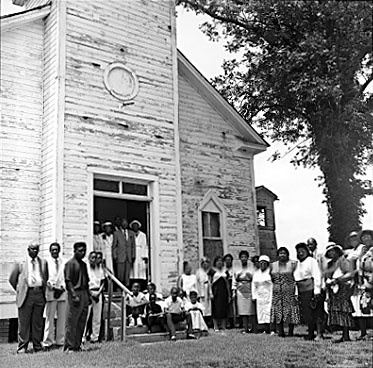
There was a time when the Black church was almost synonymous with community. It was the first place people turned for help, for belonging, for strategy, for hope. It was a balm, a strategy room, and a lighthouse all at once. It held our grief and our genius. It steadied us when the world swayed. Now let’s be clear: that old church wasn’t perfect, and it doesn’t need to be now. Holiness and humanity have always lived side by side in our sanctuaries. The goal isn’t to go back: it’s to remember what worked, repair what didn’t, and reimagine what’s possible.
I say this as someone who has two church homes, one here where I live and the one in my hometown that I grew up in. Both continue to provide me with much needed grounding and encouragement. Both have community outreach programs that I support financially. So…this isn’t a critique of them or of any particular congregation. It’s a macro-level reflection offered in care, born from gratitude for what the church has been and conviction about what it still can be.
We’re in a political reality where confusion is a tactic and exhaustion is the weapon of choice. Our people are not apathetic: they’re overextended, underprotected, and spiritually tired. Hope can’t just be preached on Sundays; it has to be practiced in how we show up for one another Monday through Saturday.
The church has to reclaim its radical imagination. The same radical imagination that birthed freedom schools, voter drives, and mutual aid long before hashtags and funders. However, it also has to shed the habits that keep people out: the judgment, the silence around mental health, the reluctance to name systems instead of just sins.

If the church is to be an anchor again, it must invest not only in its own buildings but in the economic sustainability of the neighborhoods that surround them. Beautiful church grounds mean little if the block outside is starving. What would it look like for tithes to seed co-ops, for fellowship halls to host credit repair workshops, for churches to buy back the land that was once theirs and make it ours again? That’s sacred work as well. (And to be fair, some congregations are already leading beautifully in this way, but too often, their impact remains isolated instead of amplified through shared strategy.)
If we want to be the moral center, we have to live like it. That means sermons that speak to survival and systems. It means churches that open their doors for organizing meetings and voter education just as easily as for revival. It means pastors and pew members alike learning how to talk about policy, power, and protection as acts of faith, not politics.
We can’t wait for anyone else to save us. We’ve always been our own safety net. The Black church can still be the drumbeat of our collective resilience, but only if it remembers that God’s work has always been liberation work.
Maybe that’s the message for this season: not just to believe in hope, but to become it — again.
Soundtrack of My Life: Precious Lord, Take My Hand by Aretha Franklin – Remembering Sis. Charlean Clifton today–her rendition of this song still remains my fave.




 Real Middle School Mom of Atlanta