Feature Friday: Twist

Feature Friday: Twist

As Drake says, “Better late than never.”  So here’s my review of Twist at the Alliance Theatre since I’m New Orleans-bound in just a couple of hours.


Overall, the musical was worth seeing.  This “twist” on the story of Oliver Twist was full of great music and great storylines. A result of an interracial couple in New Orleans in the early 1900s that experiences the wrath of a mob, Twist is born in the orphanage that his mother drags herself to while dying after watching her fiance carried off.  Twist is ridiculed for being a “half-breed” by the other orphans as is sold to a funeral parlor director.  During his short stint with the funeral home, Twist learns that he has a great dancing talent and shows out during a second line before running away and joining a gang of lost boys who are selling libations during Prohibition for a guy who turns out to be the dance partner of Twist’s deceased father.  This guy also just happens to be booed up with the girl who delivered Twist and got a locket from his mother before she died, which the girl still had after all those years.

The story becomes twisted when the gang leader, who also owns a cafe in the Quarter, is approached by Twist’s uncle, who happened to be a member of the mob who killed Twist’s parents.  The uncle learns that as long as he has no proof that the baby of his sister is dead, he can’t get her part of their inheritance.  So he tries to buy Twist from the gang leader, who at first, despite his girlfriend’s pleas, heavily considers the agreement.  Thank goodness for the family attorney, who just so happened to love the work of Twist’s father and who has an affinity for protecting youth, who steps in and gives Twist a safe and happy home through all of this drama.

The two main issues that came up in the musical included of course, the lack of belonging for interracial people on either side of the spectrum and the need for adult influence and love in the lives of children.  Now, I had a slight problem with the interracial aspect of things.  In New Orleans as well as in other parts of the world, interracial people were seen as a notch up from black.  So although they were not accepted by white people, they were not necessarily “rejected” by blacks–many times, they chose not to be grouped in, instead going by names like quadroon and octoroon.  Interracial people in these days of New Orleans, many times had a choice between living among blacks or living in this created world of their own, where the women became concubines of Frenchmen who traveled back and forth between lands.  So it kinda disturbed me that in the musical, blacks and whites were banding together (getting along although they killed Twist’s parents for banding together) to ostracize Twist.  It was just a really weird dynamic.  For instance, in the orphanage scene, the black and white kids were in cahoots to make Twist’s life a living hell.  Now, this may have been a little more believable if  the white kids were sitting at a table of their own and the black kids at the other, and neither would give Twist a seat.  But for them all to be seeming to be loving each other across racial lines but hating Twist?  No sense.
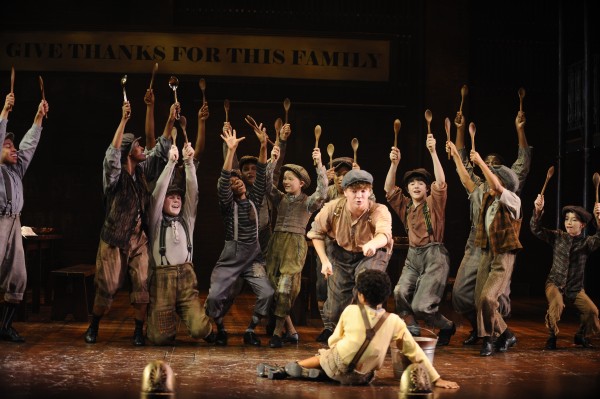
Most importantly, though, the production did a good job of illustrating that children will accept love anywhere they can get it.  Even if it’s not under great circumstances.  It made me really consider what I think about whites adopting black children vs. blacks adopting them.  I mean, in the grand scheme of things, there are so many children out there that need love that I don’t really think about what race the adopting parents are–I just want them to be good parents who really just want to love kids.  Yes, there’s the issue of ensuring culture in a child, but I’d rather a child be placed with awesome white parents than sucky black parents (as would have been the case in the production–a single well-off white attorney who loves children and can actually tell Twist about his father’s legacy versus a black couple that is shacking up and sending kids out in the streets everyday to sell illegal liquor).  But the world isn’t so black and white.  There usually aren’t situations where a kid has a choice between the exact same family besides one being black and one being white.  So, I just say, those of you out there who really have the resources and the time and the love to adopt a child, go for it.  You won’t hear anything from me, regardless of your race or the child’s race.

Again, overall, the play was enjoyable.  Check out the Alliance Theatre to see what they have this season.  Reads and Reels will be seeing Nacirema Society mid-November, and I can’t wait!
Feature Friday

Feature Friday

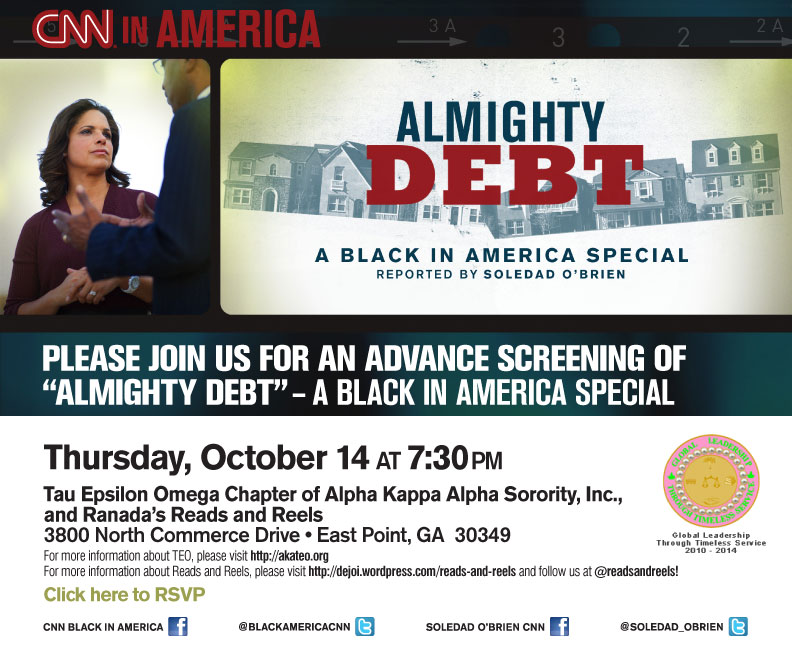
Boy, this week has been full of ups and downs, but the ups were AWESOME!! I have *three* Features, and I haven’t yet decided if I need to just spread them out over the next three weeks or if I need to find time to spill my guts about all three today.  Either way, they’re coming.  Last night’s Black in America: Almighty Debt was a well-attended event with tons of great and thoughtful dialogue.  Wednesday night I saw Night Blooms at Horizon Theatre, and the production is a must-see.  Finally, last Saturday, a couple of friends and I participated in the Atlanta Challenge, and it was uber fun.  I also owe my thoughts on a bunch of other stuff (Twist, I Dream, Soundtrack  of a Revolution, 41st and Central–I haven’t forgotten!).  Who knew I was so busy? (Yeah, I know, I know, we all did.)

So stay tuned.  And THANKS to everyone who has been joining me in all this fun!

Feature Friday: Small Businesses

Feature Friday: Small Businesses

I’m no stranger to the pros and cons, benefits and trials of owning a small business.  In addition to my own small endeavors over the years, I was exposed to entrepreneurship as a child.  My granddaddy opened Robinson Shoe Shop in 1957, and it is now operated by my daddy and one of my uncles.  I’m sure this is one of the major reasons that the passage of the Small Business Jobs Act this week was important news to me, besides the fact that statistics show that small businesses are the source of a large chunk of the jobs in this country and are important to economic development.  They are also necessary in the community development of black communities.  Part of economic empowerment is generating and producing, not just consuming.

So today, my feature is two-fold: The Small Business Jobs Act and the film Harlem’s Mart 125: The American Dream.

I saw the film in late August on a Sunday afternoon at Central Library.  Not knowing that I had just said excuse me and stepped over the film’s creator, I sat in my seat and through the grainy cinematography (which I understood is an byproduct of a one-woman budget!! How passionate and awesome is that?), learned about an establishment that was not only the lifeline of several hard-working black business owners but also to the entire community in which it was located.  The film chronicles how the Harlem’s Mart 125 in New York became to be such a force and how the business owners were let down by the society and government that tells us that we have to get up and get our own.  It saddened me to see the disinvestment of the building, despite the fact that the businesses had been there for years, attracting and maintaining customers and staying relevant to a degree through the times.  Then came the gentrification of the area, which led to the government supporting new chain businesses while not providing support for the anchors that had been holding the community up the whole while.  The creator, Rachelle Salnave-Gardner, showed us that sometimes we really just get the short end of the stick–and that short end begets so many other implications for the business owners, their families, their customers, and the culture of the community.  If you get a chance to see or host this film, I encourage you to take it.

So what does the new bill that President Obama signed this week mean?  Additional loan availability, increases in the loan amounts, a higher tax deductible  for start-up businesses, tax deduction on health insurance expenses, and lots of other stuff.  Here’s another link with some info.  I hope that people, especially black business owners and aspiring entrepreneurs, will take advantage of some of these newly passed opportunities.  We can’t control all the circumstances, but creating strong businesses and supporting those businesses hold much promise for the future of us all.

Happy Friday, folks!

Say It Ain’t So – Quality Film to Come?

Say It Ain’t So – Quality Film to Come?

I will admit, I had really (and by really, I mean extremely, intensely, immensely, extraordinarily) low expectations of Tyler Perry’s upcoming film translation of For Colored Girls Who Have Considered Suicide When the Rainbow Is Enuf, which hits the big screen in November. It just seemed too paradoxical.  While I regret that I haven’t yet read the book by Ntozake Shange (though it is on my shelfari list), I have seen the play, and I wasn’t moved.  Not because of the content, but because of the delivery.  My attention just wasn’t captured, and I found myself dozing off, which I usually wouldn’t freely admit.  I always wondered “am I just not deep enough?”

Now, place that with the other end of the spectrum.  Most know I’m not a Tyler Perry fan.  I find his productions pretty shallow and redundant.  While I admire his tenacity and success, I’m just not an avid fan.  So when I heard Tyler Perry was going to be the leader of this film adaptation, I thought this was simple math.  Too deep + not deep = #uberfail.

But then the trailer hit Twitter yesterday morning, and I’m pretty intrigued.  I hope the trailer isn’t just a ruse because it definitely changed my status of not-planning-to-see-it-ever to maybe-I’ll-go-see-it-opening-weekend.  I’m really excited about seeing Whoopi Goldberg and Phylicia Rashad on the same screen.  From the flickers of various scenes in the trailer, it looks like the film may actually be something relatable, engaging, and impelling.

It seems that just maybe too deep + not deep = just deep enough.  Do  you plan to go see this film?

Jitney

Jitney

This afternoon, a friend of mine and I went to the Alliance Theatre and enjoyed a great production written by the great August Wilson called Jitney.

Set in 1977 in a jitney stop (car service) in Pittsburgh, this production explored a range of topics still relevant to the black community, including the disconnect between generations, alcoholism, the role of men in households and families, love and forgiveness, the importance of communication between romantic partners, the effects of war on young soldiers, the lack of support for small businesses in some cities, and the list goes on.  This would have made for a great Reads and Reels discussion!

In addition to the  great music played between scenes (classics like Marvin Gaye’s “Got to Give It Up”), I really enjoyed the light banter and surefire black lingo infused into the script. The characters were real to me because I could definitely hear my daddy talking like these guys were. Although the plot was very heavy overall, the production made good use of comic relief.

It made me smile to see so many black folk at the theatre, supporting the arts. If you haven’t seen it, make sure to put this on your list of things to do this month. Jitney runs through June 27.