Ready, Set, Go

Ready, Set, Go

Yesterday, I attended the Many Voices, One Goal conference in Raleigh, North Carolina, where public and private stakeholders came together to discuss ways in which North Carolina can continue to work together to achieve the ambitious goal of preparing ALL children for college or career. North Carolina was one of the states awarded federal Race to the Top funds in the second round of competition. Governor Beverly Perdue, who holds a Ph.D. in Education Administration, announced in January 2010 her education agenda: Ready, Set, Go, which has a goal of making sure every child in North Carolina is college or career ready. Gov. Perdue, plans to achieve this through four pathways: great teachers and principals, quality standards and assessments, new data systems that track students from their first day, and a turnaround of lowest-achieving schools.

During her address, Gov. Perdue stated what we at Market Street believe: “You’ve got to have a skilled workforce, purely and simply… Jobs and education are inextricably tied together for a common goal.” After giving more details about each component of reaching the goal of preparing ALL students in North Carolina, she left us with this: “The history of North Carolina is still being written. This chapter belongs to us. It’s our opportunity to transform a child’s life…” This is what took me from saying that her goal was lofty to ambitious. She gets it. She KNOWS that she has to reach those kids on the margin to improve the lives of everyone. We can’t continue to ignore those “doomed to fail” if we really are looking at our long-term future. As Whitney Houston said, the children ARE our future so we have to prepare them all, not just some.

Dr. Uri Treisman, a professor of mathematics and public affairs (MY kinda guy!!) at UT-Austin and considered an expert in education innovation, gave a keynote that highlighted America’s strengths in education. He said that although we have a ways to go to improve, that we should give ourselves credit for the progress we’ve made. Dr. Treisman stated that when it comes to the TIMSS (Trends in International Mathematics and Science Study) educational metric, the US performs better than all European countries. Minnesota and Massachusetts, who have chosen to be ranked along with the nations, both outperformed Japan, and Massachusetts did just as well as Singapore. However, the United States ranks 25th of 30th in the PISA (Program for International Student Assessment). The difference, according to Dr. Treisman, is the TIMSS focuses on procedural knowledge, or how to follow rules, while PISA focuses on the ability to use knowledge in unfamiliar situations. He asserted that in order for our students to have the ability to solve creative problems, they need an education that balances both of these. *Lightbulb* The second part is critical thinking–something we’re constantly complaining about, esp with the Millennial generation. Education reform can’t just be about passing tests and getting through school. It HAS to be about preparing students for LIFE. This discussion of policy from a mathematical and statistical perspective, just my cup of tea, was really interesting, and I think the folks in the audience got some great ideas about how to approach reform issues.

I then attended a workshop entitled Innovative Models for School Transformation: Learning from the Many Voices of School Innovation across North Carolina during which I tweeted about how misty I was getting. In this workshop, the presenters were the students of three innovative school models across the state and an administrator for a fourth:

  • EE Miller Elementary in Cumberland County, which is a part of the Global Schools Network – the third graders presented a powerpoint presentation about insects entirely in Spanish, which they’ve been learning since Kindergarten. The group was multi-cultural, and about 4 of them were black. It was something else to see these little people grabbing for the mic, not shy in the least, to show off their science and Spanish skills.
  • For my teacher friends who will appreciate this: the principal of a school in a small, rural, county told us about The Collaborative Project, which is sponsored by the NC Public School Forum and the NC Science, Mathematics, and Technology Education Center to provide quality staff development. The program has greatly increased the success of teacher recruitment and retention in these areas by providing teacher financial incentives and hands-on learning opportunities throughout the year.
  • A student from KIPP Institute in Gaston told us about how the school has turned a peanut field into an innovative school that expects and prepares each student to attend college by engaging families and the surrounding community. Their students have been accepted to schools all over the country and have seen very positive results. This student has already been accepted to several of the schools, including Morehouse, to which he applied and is waiting on a few more responses. He was a great public speaker–you could tell he was nervous, but he held his own, with great volume and clarity and not reading from his slides.
  • A group of students from Anson New Tech High School split up and spoke with each table in the room about their school’s programs and opportunities. The school, which promotes “trust, respect, and responsibility,” focuses on project-based learning and a wide array of technologies. The students work on oral presentations, team work, and individual learning, while weaving in technology in all facets of school. An afro-wearing kid came to my table and chatted enthusiastically about the projects he’s worked on and how in team situations, they could fire someone not pulling their weight. Armed with his Macbook that each student has but has to earn the right to take home, he let us listen to a song he created, beats and all, for a math project.

There was a panel about public ed in NC featuring Bill McNeal, Leslie Winner, and Dale Whitworth, and one important idea came up for me–education is a public good–not a private good. Ding ding ding. Public education shouldn’t be a free enterprise system that doesn’t support all children. Education is not just about individual benefit–it’s about collective benefit–bringing up our entire community, not just one child. It’s about preparing kids to meet the challenges of ALL of our futures. Leslie Winner made the point that there have been four reasons for public education that still apply today:

  1. “If we’re going to have a successful democratic society, we have to have a well educated and healthy citizenry.” — Thomas Jefferson. Now y’all know I think some people are a-ok with uneducated folks because then they don’t question anything. If we want kids who will be engaged in what’s going on in our communities and nation, we need them to be able to think critically and ask questions–not just go along to get along.
  2. In the early 1800s, education was a means to ensure social order. That still applies. When you’re prepared for a good job, you’re less likely to get into mischief. When Jackson was off the chain crime-wise, I was telling folks that crime fighting wasn’t the sole answer–economic development is important too. You have to give folks something to do. Idle minds are a devil’s workshop, right?
  3. In the late 1800s, as the country was moving away from farming and such to manufacturing, workers and leaders needed training to make that transition. The same applies today as we move into the “New Economy” that is so intertwined with technology and innovation.
  4. Finally, education was necessary to enable to the South to face the future as a part of the country. Well… many southern states at at the bottom of so many of the rankings lists. Again, we need to pull up the margins to pull up competitiveness.

The final keynote of the day was from Dr. Linda Rosen, CEO of Change the Equation, which was launched in 2010 after President Obama reached out to the leaders of Xerox, Kodak, Time Warner Cable, Intel, and Sally Ride Science. Change the Equation is a nonprofit, non-partisan initiative to solve America’s innovation problem. Their goal is to improve STEM education for every child, with a particular focus on girls and students of color, who have been underrepresented in STEM fields. Dr. Rosen told us that although corporations give a half billion dollars in philanthropy in STEM learning, it hasn’t been as effective in return on investment and her organization plans to reroute those funds to ensure efficiency and effectiveness. They are currently developing design principles for philanthropy—ensuring that organizations who receive the money fit within criteria that are most likely to see results. They also plan to release this spring STEM Vital Signs, which will start with a compilation of existing state STEM data and evolve to include new data not currently available.

North Carolina is positioning itself to become a model for other states, and I applaud their efforts. They’re reaching into rural areas and low-income areas to try to figure out how to bring everyone along. I hope that other places (ahem, Georgia, ahem, Mississippi, ahem, keep naming states until I start forgetting them) get the idea asap and follow suit.
More Violence

More Violence

I would be remiss if after my last post I didn’t say anything about DJ Henry, the slain Pace University student. Three initial thoughts came to mind as I heard it discussed on the Tom Joyner morning show.

1. As much as I’m on the internet reading the news, I had never heard of this, an incident that occurred in October. So I just wonder how often this type of thing happens, and we just don’t know about it. Seriously, we need to do something. Whether it be training our young men on how to deal with the police, whether there is just cause for the encounter or not. I’ve been in a situation myself where I’ve been harassed by the police, and I was calm for awhile until I just lost my patience.  I wasn’t hit or anything, but I was given 3 tickets, which were thrown out when I went to court, but I recognize that a-it was a luxury that I was able to take time off work to go to court and b-that I knew my rights and thus knew the tickets wouldn’t hold up if I contested them.  Just like there was training for sit-ins, maybe we should have trainings for police stops. It can be infuriating when you feel like you’re being picked on, but we really have to learn how to go along to get along sometimes–especially if death or wrongful imprisonment is a possibility. And we need to know what the laws and ordinances are.  (And I say all that not to say what I think happened in this situation–I really don’t know what to believe happened to DJ Harvey.  I do know I haven’t heard or read anything yet that justified killing the young man.)

2. I’m happy that black media is covering this.  We really need to support and take advantage of the media outlets we do have to increase awareness and spur action.  We do not/should not read everything we read (as was the case of Shirley Sherrod), and we need to know who is reliable and where we can really make sure our voices are heard.

My heart goes out to the family and the school body as they figure out what actually happened that fatal night.

Racism in America, not just MS

Racism in America, not just MS

The inspiration for this post started with this article.  A few days ago, a friend of mine from Greenwood texted me to tell me there had been a lynching in her hometown.  A couple of days later, the article came out suggesting it was a suicide.

In the words of Ed Lover, C’MON SON, get the eff outta here with that bs.  Do you seriously want me to believe that?

The other issue I have with this article is that there are NO comments.  Now, I am a dedicated comment reader because comments can really paint the picture of who is living in this country and how they see the world.  I’ve winced a many day at comments that I’ve read on an array of topics, so I was prepared to read some on this one, but… Crickets.  What’s up with that?

Let’s call a spade a spade.  This is yet another example of hatred and racism in this country.  In 2010, the fact that someone could be lynched is a travesty.  And the fact that it hasn’t hit all the major news outlets yet is another.  But, I must admit, a small part of me is glad it hasn’t.  Wanna know why?

I get tired of the perpetuation of the negative stereotype of my home state.  I started this group on Facebook and am very happy to see that there are over 13,000 members in it.  Why?  Because so many people, outside of the state and even in the state, think that MS is the hub of all evil in the country and that nothing good comes from it.  Ok, that’s a slight exaggeration, but still.  I’ve heard people from all across the Bible Belt give MS grief as if their states don’t come with their own transgressions.  If you don’t know much about Mississippi and all of its contributions, you should browse this site for a few minutes.

Now, let’s be clear.  I do not for one second believe that Mississippi doesn’t have its problems or that it’s a perfect place.  And I don’t need another lesson on Mississippi history.  I got it along with southern history, American history, and Black history.  I just want to intimate that racism and the brutal killings of our black men is a NATIONAL problem.  Oscar Grant being shot in the back while unarmed is just as horrible as this poor man who was walking through the wrong neighborhood and somehow (since it could be self-inflicted <heavy sarcasm>) ended up hanging from a rope in a tree.  However, no one says that California is a hotbed for racism.  Sean Bell being gunned down by the police before his wedding?  Yep, not cool.  But no one blames it on the fact that he was in New York.

How about the man who was shot in the head and dragged by a car in South Carolina?  Are you getting my drift?

Now that I’ve gotten that out of the way.  I want to know who out there cares.  What’s going to happen?  What is the answer?  How can we stop all this violence and hatred?  Will people be marching to the Mississippi Delta?  Or will this slide under the radar like many other issues?  We as Americans really need to address this and while we’re at it address the disproportionate number of black men in prison and what’s wrong with our system.  We can’t just sit around and wonder when the next brutal “accidental” murder will occur.  It’s time out for thinking that if we cover our eyes, not only will we not see it, but it’ll stop happening.  We need to wake up and see that it doesn’t just affect the families of the victims–it affects us all.  So let’s get to work.

Feature Friday: Afrika Book Café

Feature Friday: Afrika Book Café

I hope all of you had a blessed Thanksgiving!

Wednesday, I visited the Afrika Book Café, located at 404 Mitchell Street in my hometown Jackson, MS.  This much needed black-owned book store is in the Fondren area and has books, African inspired jewelry, African clothing, music, incense, and oils at great prices.  I had the fortunate opportunity to talk at length with one of the store owners Dr. Sizewe Chapman, who is originally from Jackson and wants to see and help the city of Jackson grow and prosper.  After discussing economic development in Jackson, he recommended I read Black Labor, White Wealth by Claud Anderson.

Another book, The Polished Hoe by Austin Clarke, caught my eye, so I purchased those two and look forward to reading them.

Now I wish I were flying back to Atlanta so I could get started!

After browsing through all Afrika Book Café has to offer, I sat on the porch with the store owners (a beautiful married couple!) and Skipp Coon and his wife (another beautiful married couple! Black love lives!).  One of the things I miss most about home is the simplicity but profundity of sitting on a porch learning from each other and talking about the world and what we can do and are doing to make it better.  Skipp, Sizewe, and I talked strategy, history, our reality, and dreams.  Sizewe, a former African history professor at Jackson State University, really inspired me to keep reading and finding historical significance and lessons as I move forward in trying to affect positive change in the black community.  Skipp, who is a rapper who speaks the truth (and someone whom you should support!), and I finished a conversation we had awhile back about colonies, and we shared stories about our experiences as blacks traveling in Europe.

Lemme tell you, my visit to Afrika Book Café is one of the highlights of my trip home.  If you’re in or near Jackson, I encourage you to check this treasure out.  It’s still a new business, so let’s make sure it stays open, serving our community by providing educational and mind-expanding resources and a space for community interaction.  Go support this small business! And while you’re at it, support Skipp Coon!

Feature Friday: Green Building

Feature Friday: Green Building

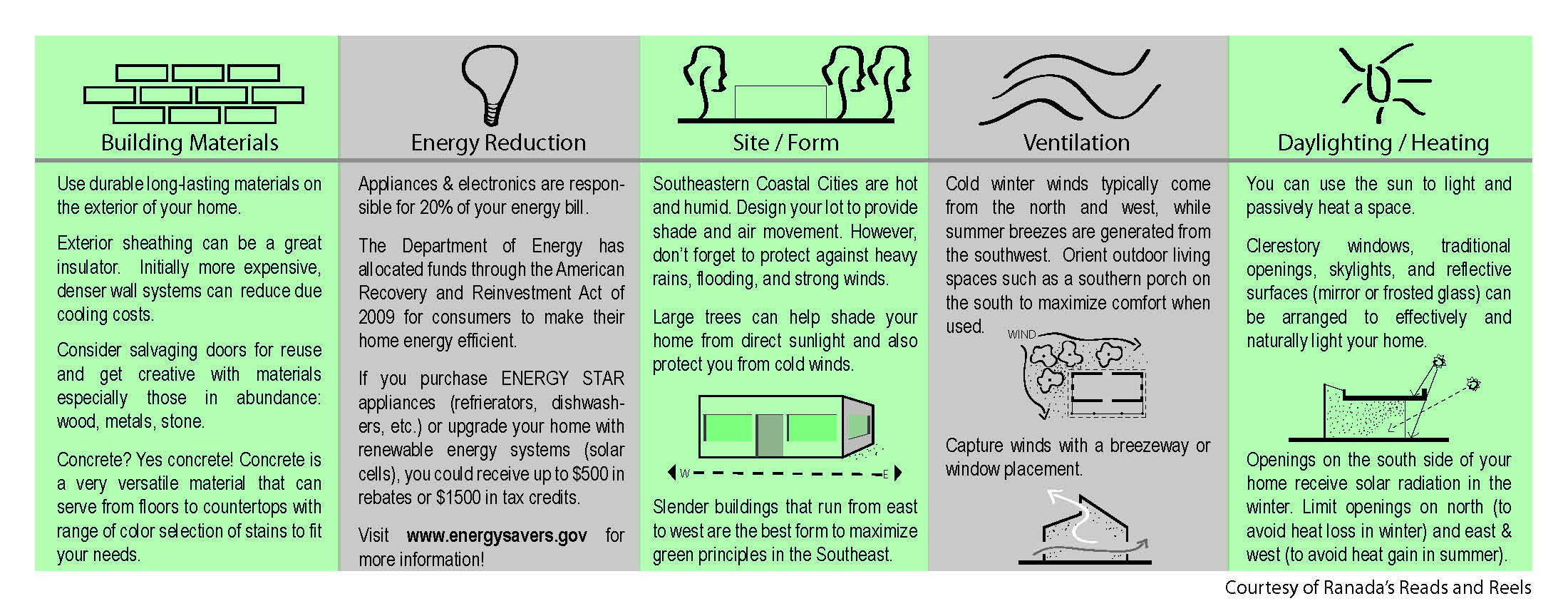
In preparation for our New Orleans’ volunteer trip, one of my group members helped me tremendously (and graciously!) by creating a card that gives green tips in building to give to organizations and residents who may be interested.  As a Feature, I’m giving Sirobe a shout out (soon to be one of less than 300 black women architects!!) and the tips in case any of you are doing any home improvements over the holidays.

Here are a couple of the tips:

  • Since appliances and electronics are responsible for 20% of the average energy bill, it pays to make your home more energy efficient.  You could receive up to $500 in rebates or $1500 in tax credits if you purchase Energy Star appliances.  Visit www.energysavers.gov for more information!
  • If you’re moving any time soon, remember that large trees are your friend.  They can help to shade your home from direct sunlight as well as block cold winds.

If you know any one building a house or anyone who is rebuilding on the Coast (or anywhere else), send them to my page.  They can contact Reads and Reels for more information.

I rock!

I rock!

Sunday night, BET aired Black Girls Rock, and it was so awesome!  It’s about time we see some positive, inspirational, motivational, strong images of black women in the media.  BET did this one right.  Working with Beverly Bond to give more exposure to the positivity her initiative exudes, this program did wonders for grown black girls and small black girls alike.  If you missed it, I encourage you to watch it, whether you’re a black girl or not.  You can catch it online at the link above.

So let’s spread some love on my page today.  Share with me why YOU rock!

Why do I rock?  I rock because I’m a risk taker.  I dream and then I go after them.  I rock because I’m a M.A.D. black woman–one who’s making a difference.  I’m a change maker.  I rock because even though I’m a rough and tough with my afro puffs at times, I’m versatile–I’m also a softspoken, sensitive southern belle who loves alliteration and all things vintage and frilly.  I rock because I know my style and I love myself for it.  I rock because I want to be an influence on those around me.  As Iyanla Vanzant said Sunday night, I rock because I have no other choice.

Here’s one of my fave parts of the show.

Why do you rock?  Tell me!

Have you voted?

Have you voted?


If you haven’t voted already, what are you waiting for? Here are links to some previous posts about voting.

Are you ready for the midterm elections?

GA Primary: Election Results

Are you ready for the primary?

Here are some other useful links.

MoveOn.org Election 2010 Voting Info

CNN Election Center

Washington Post Vote Tracker

Usually I’m a little impatient when it comes to standing in lines, but this morning, I was very happy and gleeful to stand in line to vote. It was really encouraging. I hope the expected turnout is surpassed greatly. Some ask why I didn’t early vote–there’s just something about voting on Election Day that makes me feel empowered. I only early vote when I know I can’t fit it in on the actual day, but I totally support making voting more accessible.  I just like being in the thick (or thin, in which case I frown) of things.

I’m also very very ecstatic to see that people have been following my suggested links to the Secretary of State website, the layman’s version of the proposed amendments, and info about candidates.  🙂

Anywho, if you’ve voted, ^5!!! If you haven’t, you have till 7 pm. Get it done!!

Almighty Debt

Almighty Debt

So last week, Reads and Reels along with TEO hosted an advance screening of CNN’s Black in America: Almighty Debt, which is airing in full tomorrow night. The event was well-attended, and people definitely had lots to say about the segment.  Here are some highlights.

  • Many people in the group, while they appreciated the topics touched on in Almighty Debt, felt that there should have been an added focus on those who have triumphed over debt.  They expressed that instead of showing all our problems, showing people who have overcome debt issues would have provided some hope to the watchers.  Some people thought the segment was realistic, and some thought it didn’t represent enough of the black diaspora.
  • In the piece, Pastor Soaries said that debt is a bigger problem than racism.  Some agreed, but others did not.  One attendee said that this debt problem is a byproduct of racism, and that there are still systems that encourage a disproportionate affect on our community in comparison to others.  She even made reference to a quote from the first Black in America: “When America has a cold, Black America has the flu.”  In essence, financial issues affect us greater–as Julianne Malveaux said during her interview, many of us are middle class by income, not by wealth.  So when stuff happens, we don’t have as much cushion, and we’re more easily knocked out of middle class.  It’s troubling that the wealth gap between whites and blacks is $75,000.
  • One point that was made over and over again in the segment as well as in our discussion is that we get emotionally attached to our stuff.  Due to a long history of not having much, it was said that we spend a lot of our money trying to catch up and show that we’re worthy of having stuff — stuff, as in houses, cars, clothes, designer purses, etc., that we can’t or won’t let go of when times get tough.  I shared with the group that in 2007, black buying power was $845 billion and was expected to top $1.1 trillion by 2012.  What are we doing with this money?  Why aren’t we leveraging it? Why are we buying tons of stuff instead of investing in our communities, in black businesses, in our education systems, in programs that will help us?
  • One very important topic of this new segment of Black in America is the church’s role.  Should the church be focused on salvation–getting people to heaven–or should it also be teaching and advocating for our communities–helping people on earth?  (Y’all know I think it should be doing both.)  The church, which used to be the single most important institution in our communities, should be investing in building up our communities.  I am in support of those churches, including the one in the documentary, who have community foundations that buy property and help people find jobs and teach financial literacy and help people get out of debt and hold entrepreneurship workshops and the like.  We need to think beyond our individual selves and get back to thinking long-term for our community.  We know what many of our problems are–so let’s get to fixing them.

There was so much more that was said, and there is so much to be said–and to be done.  Overall, I think the screening, and I’m sure the complete show tomorrow, fulfilled an imperative purpose: to get us talking about what we need to do become better financially.  It’s a personal and community problem–we each have a responsibility to get our own lives in order and make better decisions; and we all need to chip in and do something to position future generations to be better stewards of money and to understand how to build wealth, not just increase income, or as one participant said: “make money while we sleep.”

One thing that I’d like to see expanded and implemented to a wider audience is our ESP Kids Club, where members of TEO along with some brothers of Alpha Phi Alpha teach middle school kids on Saturdays about financial literacy.  The program is so enriching that some parents have asked to sit in because their kids were going home sharing information that the parents didn’t know!

There’s an information gap from which our community suffers gravely.  We need to fill it in order to empower the black community economically.  We have to have the foresight to ensure that our $1.1 trillion will be spent creating products, innovating, and growing assets, not just being consumers.

Feature Friday: Small Businesses

Feature Friday: Small Businesses

I’m no stranger to the pros and cons, benefits and trials of owning a small business.  In addition to my own small endeavors over the years, I was exposed to entrepreneurship as a child.  My granddaddy opened Robinson Shoe Shop in 1957, and it is now operated by my daddy and one of my uncles.  I’m sure this is one of the major reasons that the passage of the Small Business Jobs Act this week was important news to me, besides the fact that statistics show that small businesses are the source of a large chunk of the jobs in this country and are important to economic development.  They are also necessary in the community development of black communities.  Part of economic empowerment is generating and producing, not just consuming.

So today, my feature is two-fold: The Small Business Jobs Act and the film Harlem’s Mart 125: The American Dream.

I saw the film in late August on a Sunday afternoon at Central Library.  Not knowing that I had just said excuse me and stepped over the film’s creator, I sat in my seat and through the grainy cinematography (which I understood is an byproduct of a one-woman budget!! How passionate and awesome is that?), learned about an establishment that was not only the lifeline of several hard-working black business owners but also to the entire community in which it was located.  The film chronicles how the Harlem’s Mart 125 in New York became to be such a force and how the business owners were let down by the society and government that tells us that we have to get up and get our own.  It saddened me to see the disinvestment of the building, despite the fact that the businesses had been there for years, attracting and maintaining customers and staying relevant to a degree through the times.  Then came the gentrification of the area, which led to the government supporting new chain businesses while not providing support for the anchors that had been holding the community up the whole while.  The creator, Rachelle Salnave-Gardner, showed us that sometimes we really just get the short end of the stick–and that short end begets so many other implications for the business owners, their families, their customers, and the culture of the community.  If you get a chance to see or host this film, I encourage you to take it.

So what does the new bill that President Obama signed this week mean?  Additional loan availability, increases in the loan amounts, a higher tax deductible  for start-up businesses, tax deduction on health insurance expenses, and lots of other stuff.  Here’s another link with some info.  I hope that people, especially black business owners and aspiring entrepreneurs, will take advantage of some of these newly passed opportunities.  We can’t control all the circumstances, but creating strong businesses and supporting those businesses hold much promise for the future of us all.

Happy Friday, folks!